▣ TYPE: Demonstrator / Retrofit
▨ CLIENT: London Borough of Newham
▤ KEY MATERIALS: Reclaimed CLT / Wetland Boards
▦ METHODOLOGY: 1:1 Prototyping
▥ COLLABORATORS: Tipping Point East / Yes Make / RESOLVE Collective / Mayor of London / London Borough of Newham
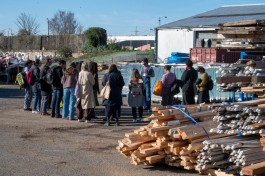
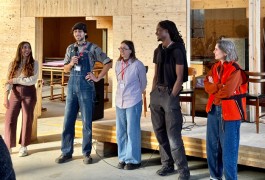
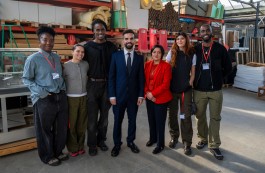
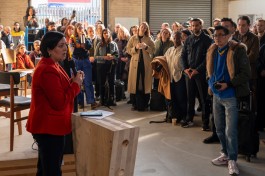
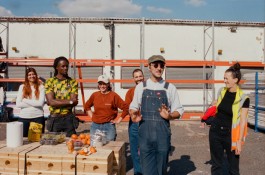
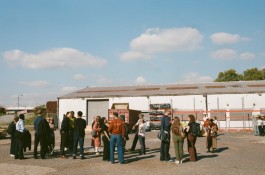
Tipping Point East is the largest climate futures centre in Europe. The 7,000 sqm site is established by Yes Make, Material Cultures and RESOLVE Collective, supported by the Mayor of London and the London Borough of Newham. Combining circular and bio-based materials at scale, Tipping Point East will unlock critical capacity for low-carbon construction through vital infrastructure to store, process, and redistribute materials from across the construction industry into new projects. It will also support circular and bio-based skills training and a range of activities bringing these approaches to the everyday lives of our neighbouring communities in Newham.


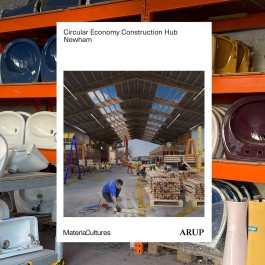
Tipping Point East was catalysed by research and models developed by Material Cultures and Arup for LB Newham in 2022. The 'Circular Economy Construction Hub' report demonstrated the value of critical infrastructure for the circular economy in London that would be uniquely positioned to support the GLA and local authority objectives to shift away from the linear material use prevalent in construction today (‘make, use, discard’) and towards a circular construction economy while also supporting high-quality jobs and unique training and educational opportunities for residents and newcomers alike.
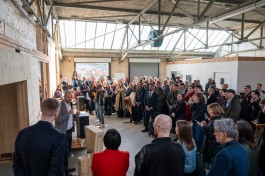
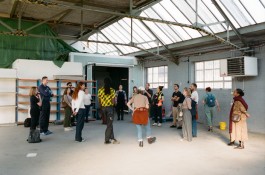
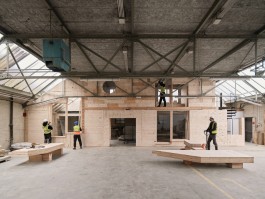
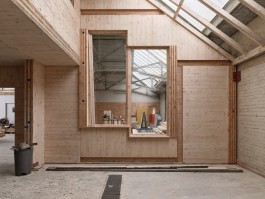
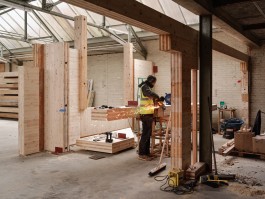
The retrofit of one of the existing warehouses on site is a collaboration between Material Cultures & Yes Make. It will accomodate the Tipping Point East programme and will utilise only reclaimed materials: a structure formed from a hotel CLT floor slab; bespoke windows adapted from office glazed partitions; custom metal brackets fabricated from I-beam offcuts; and insulating wools from theatre flats. The building was engineered to maximise the potential of reused materials and celebrate these details throughout. It is also designed for disassembly and future reuse.

Photography by Henry Woide, Michael Sabuni, Stephen Young and Steve Gilchrist
▣ TYPE: Demonstrator / Retrofit
▨ CLIENT: London Borough of Newham
▤ KEY MATERIALS: Reclaimed CLT / Wetland Boards
▦ METHODOLOGY: 1:1 Prototyping
▥ COLLABORATORS: Tipping Point East / Yes Make / RESOLVE Collective / Mayor of London / London Borough of Newham
Tipping Point East is the largest climate futures centre in Europe. The 7,000 sqm site is established by Yes Make, Material Cultures and RESOLVE Collective, supported by the Mayor of London and the London Borough of Newham. Combining circular and bio-based materials at scale, Tipping Point East will unlock critical capacity for low-carbon construction through vital infrastructure to store, process, and redistribute materials from across the construction industry into new projects. It will also support circular and bio-based skills training and a range of activities bringing these approaches to the everyday lives of our neighbouring communities in Newham.

Tipping Point East was catalysed by research and models developed by Material Cultures and Arup for LB Newham in 2022. The 'Circular Economy Construction Hub' report demonstrated the value of critical infrastructure for the circular economy in London that would be uniquely positioned to support the GLA and local authority objectives to shift away from the linear material use prevalent in construction today (‘make, use, discard’) and towards a circular construction economy while also supporting high-quality jobs and unique training and educational opportunities for residents and newcomers alike.


The retrofit of one of the existing warehouses on site is a collaboration between Material Cultures & Yes Make. It will accomodate the Tipping Point East programme and will utilise only reclaimed materials: a structure formed from a hotel CLT floor slab; bespoke windows adapted from office glazed partitions; custom metal brackets fabricated from I-beam offcuts; and insulating wools from theatre flats. The building was engineered to maximise the potential of reused materials and celebrate these details throughout. It is also designed for disassembly and future reuse.

Photography by Henry Woide, Michael Sabuni, Stephen Young and Steve Gilchrist
E info@materialcultures.org
T 07707592097
E info@materialcultures.org
T 02030626832